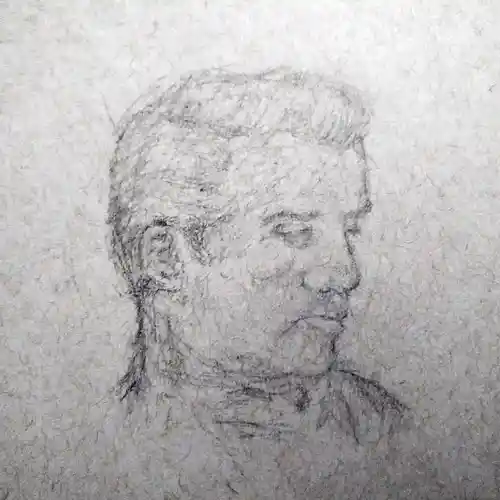
 Om dat de werelt is soe ongetru
Daer om gha ic in den ru1
Because the world is so beguiled
Therefore I go into the wild.
Because the world is so untrue,
Therefore I go in rue.
Because the world is so defiled,
Therefore I go into the wild.
I work from archival and contemporary film sources to create electronic paintings of significant social and political events—the tragedies, histories and sometimes comedies of the 20th and 21st centuries.
The work employs the compositional techniques of history paintings or "story painting" using manipulated details2 of people, architecture and landscapes, meticulously selected from film and video stills, photographs, crime scene documents, maps and street views to create the final tableaux, striving for historical accuracy while taking poetic license with time and perspective.
These mise-en-scènes are composed from the fragmented moments of events2 captured on film and are aided by historical accounts, literature, forensic documentation, and contemporary street views. The visual narratives are historically accurate while taking poetic license with time and perspective.
I sample as many contemporaneous sources as relevant to the composition and strive for historical accuracy, taking poetic license in the drama of the moments chosen to depict these stories.
The work is indebted to the intrepid documentarians who recorded these events for posterity.
N.B. Measurements indicate maximum print dimensions but are variable.
Gordon Belray is an artist who creates electronic paintings based on archival and contemporary film sources, depicting significant social and political events of the 20th and 21st centuries. His historically grounded yet poetically interpreted visual narratives are composed from fragmented film moments, literature, forensic records, and street views.
I make narrative paintings of significant figures and events using archival and contemporary sources to reconstruct the tragedies, histories and sometimes comedies of the 20th and 21st centuries.
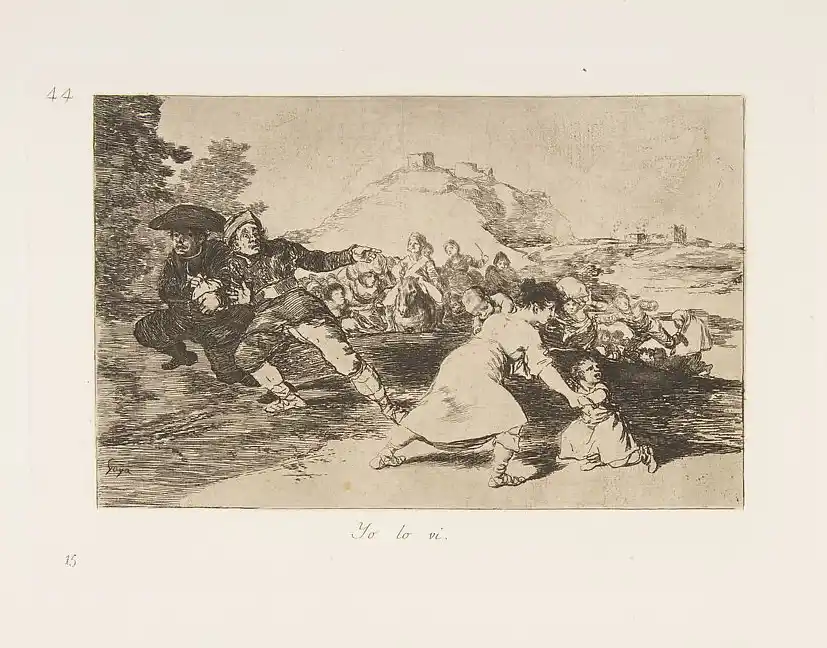
For me, within the vast visual archive lies a hidden singular composition that I assemble and mould from an almost endless array of fragments2 into a whole of space and time. I cannot say what compels me to a subject; perhaps it is the act of witnessing the ineffable from various angles, tracing back to an innocence lost while watching Lee Harvey Oswald being gunned down on a Sunday morning on live television3. While Goya did not make known his intent for creating the print series The Disasters of War4, the horrific beauty of the plates and their titles, such as no. 44's Yo lo vi, “I saw it”, more than suffice. Equally for me, then, there is little to add beyond "I searched it."
The finished work is additionally informed by the oral accounts and histories of those present, forensic documents and maps, the architectural facades and elaborate interiors, the landscapes and streets preserved in old photographs and navigable modern street views, illuminated by the light of the moment. Most critically, it is the gestures of humanity, both heroic and cruel, that I attempt to make seen anew.
While the work is historically accurate down to the minutiae, the nature of its telling needs must take poetic license with time, perspective and composition.
The images of jazz artists continue a practice of drawing musicians in nightclubs that I began as a young man.
The paintings are indebted to those compelled to record what they saw.
Exhibitions & Publications
-
“Sounds of Resistance"
Der Greif Guest Room, April 11, 2025
Curated by KJ Abudu
-
The Persistence of Vision
Hamilton Arts & Letters, Issue 16, 2023
Kim Echlin Guest Editor
-
Neverland and the End of the World
2022.11.25 — 2023.01.03
Jimei x Arles Internation Photography Festival in Xiamen, China
Curator/Curatorial Team: Tangent Collective
-
International Photography Annual 7
June, 2020
Manifest Gallery, Cincinnati, Ohio,
-
Lumumba in the Arts
Edited by Matthias De Groof
Jan, 2020
Leuven University Press
-
Nuclear Visions: The Atomic Photographers Guild
Sep 20 - Oct 31, 2019
John and June Allcott Gallery, The University of North Carolina at Chapel Hill, NC
-
10th Annual NUDE
A Decade of Exploring the Uncovered Human Form
Manifest Gallery, Cincinnati, Ohio, Aug 16 - Sep 14, 2018
-
Amerikaanse kunstenaar Gordon Belray geeft moderne geschiedenis facelift
de Volkskrant, Netherlands, July 3, 2018
-
Wat Trump en Kim Kunnen Leren van Nixon en Mao
de Volkskrant, Netherlands, June 6, 2018
-
Martin Luther King: 50 Years Later: His Life and Legacy
Condé Nast Special Editions, New York, March 2018
-
INPHA 6 INTERNATIONAL PHOTOGRAPHY ANNUAL
Manifest Gallery, Cincinnati, Ohio, Summer 2018
-
INPA 7 INTERNATIONAL PAINTING ANNUAL
Manifest Gallery, Cincinnati, Ohio, Summer 2018
-
THE PRINT CENTER PHOTO REVIEW AWARD
Philadelphia, PA, 2017
-
SEMI-FINALIST 8TH ANNUAL MANIFEST ONE PRIZE
Manifest Gallery, Cincinnati, Ohio, Nov 2017
-
MEMORY LANDS
B # S Gallery, Treviso, Italy, Nov 11th - Dec 2nd, 2017
-
AFTER HIROSHIMA
Treviso, Italy, Aug 6th - Oct -6th, 2017
-
PLACE
Manifest Gallery, Cincinnati, Ohio, Mar 14 - Apr 7, 2017
-
SEMI-FINALIST THE PRINT CENTER'S 91st ANNUAL INTERNATIONAL COMPETITION
The Print Center, Philadelphia, Pennsylvania, May 2017
-
SEMI-FINALIST MANIFEST EXHIBITION ANNUAL ONE 7 - The Manifest Prize
Manifest Gallery, Cincinnati, Ohio, Spring 2017
-
GET NOTICED: 16 NEW ARTISTS SELECTED BY MARIANNE KATZMAN AND RICHARD RHODES
the red head gallery, Toronto, ON, Dec 9, 2016
- MÉMORIAL DE VERDUN
Verdun, France, Spring 2018
-
INPHA 5 INTERNATIONAL PHOTOGRAPHY ANNUAL
Manifest Gallery, Cincinnati, Ohio, Spring 2017
-
FOTOMUSEUM, SITUATION #43: Der Greif, (Un)filtered Scenarios.
An Experiment in Distributed Selection
Der Greif, Augsburg, Germany, 17 September – 27 November 2016
-
LANDS OF MEMORY: INTERNATIONAL CONTEMPORARY ARTISTS REVEALING WAR LEGACIES
The Battlefield Museum,Vittorio Veneto, Italy, Oct 6 - Oct 25, 2016.
-
MEMBER ATOMIC PHOTOGRAPHERS GUILD
August 2016
https://atomicphotographers.com
-
CONTEMPORARY ART PHYSIS & TÉKHNE Contemporary Artists in Comparison with Technology and Nature in the ‘900 Conflicts
Società Cormonese Austria Gallery, via Matteotti, Cormons, Italy,
June 24th, 2016
-
SINE LINEA REENACTMENT International Contemporary Artists in Comparison with the Demarcation Lines of the ‘900 conflicts
Izola, Slovenija, April 16th, 2016
-
CONTEMPORARY ART PERSPECTIVE ON WAR International Contemporary Artists Revealing War Perspectival Deceptions
Trieste, Italy, March 17th, 2016
-
Kathernine Mulherin Gallery Contemporary Art Projects
Toronto, Canada
