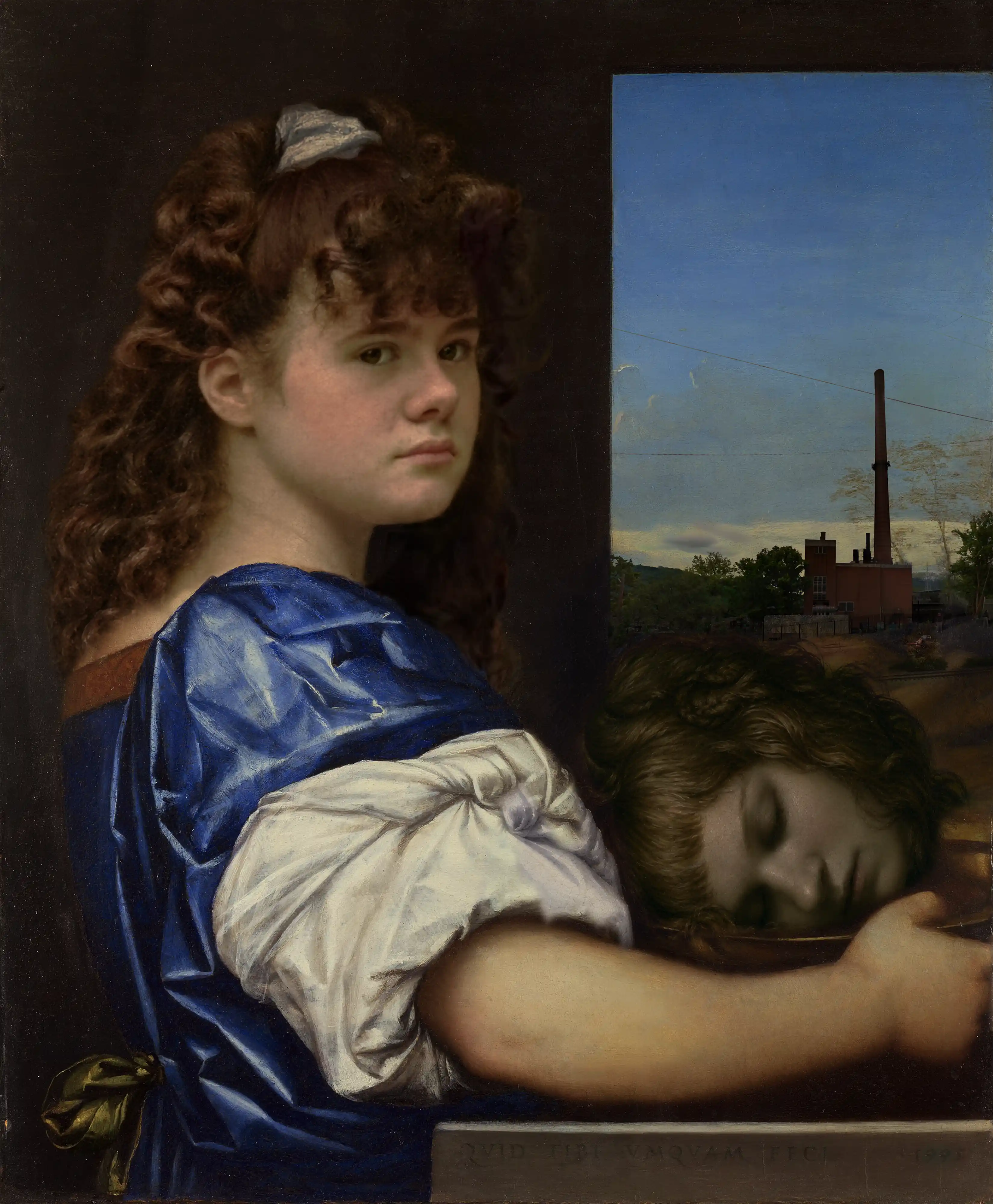
Quid tibi umquam feci 1995 (Latin: What have I ever done to you?) is an electronic painting of convicted murderer Christa Gail Pike, based on Sebastiano del Piombo’s Judith (or Salome?), painted circa 1510.
On January 12, 1995, when she was 18, Pike and her boyfriend, 17-year-old Tadaryl Shipp, brutally tortured and murdered 19-year-old Colleen Slemmer in a wooded area behind an abandoned steam plant on the University of Tennessee's agricultural campus in Knoxville. All three were participants in the Job Corps program and lived at its residence on Dale Avenue. Slemmer was beaten, slashed, and had a pentagram carved into her chest before Pike killed her by crushing her skull with a large chunk of asphalt. Her body was discovered the following morning by two university physical plant employees.
Pike had become convinced that Slemmer, who was studying computer technology through Job Corps at the suggestion of her grandfather, was trying to steal her boyfriend. Along with their friend, 18-year-old Shadolla Peterson, another Job Corps participant, Pike and Shipp lured Slemmer to the abandoned steam plant with an offer to make peace and smoke some cannabis.
Upon arrival at the secluded location, Slemmer was attacked by Pike and Shipp while Peterson acted as lookout. According to court testimony, for approximately 30 minutes, Pike and Shipp taunted, beat, and slashed Slemmer. During the attack, Slemmer begged for her life, asking, “What have I ever done to you?”
Pike kept a fragment of Slemmer's skull as a souvenir and, upon returning to the Job Corps residence, showed it to other participants and boasted about how she had obtained it. Even so, Pike insisted that she and her co-conspirators had merely intended to frighten Slemmer and that their plan had gotten out of control.
Pike and Shipp were arrested within days of the murder and subsequently confessed. On March 22, 1996, Pike was convicted of first-degree murder and conspiracy, and on March 30 was sentenced to death by electrocution, becoming the youngest woman on Tennessee's death row. Pike's defense presented evidence of childhood abuse, family substance abuse and psychological impairment, while subsequent appeals introduced additional evidence concerning her mother's heavy drinking during pregnancy, childhood seizures, possible neurological impairment and bipolar disorder.
Shipp was convicted of first-degree murder and sentenced to life imprisonment with the possibility of parole, his age at the time of the crime preventing him from receiving the death penalty. Peterson agreed to a plea deal on a reduced charge of accessory to murder in exchange for her testimony against Pike and Shipp.
On September 30, 2026, the State of Tennessee attempted to execute Christa Pike by lethal injection, but she survived the administration of two doses of pentobarbital. Initially in critical condition, she recovered sufficiently to be discharged from hospital and, on October 10, was transferred back to the Debra K. Johnson Rehabilitation Center, where she had been imprisoned for much of the preceding three decades. Pike became the first known person in United States history to survive an execution attempt after receiving lethal-injection drugs.
The painting consists of manipulated images from court, crime-scene and street-view photographs, combined with a digital reproduction of Sebastiano del Piombo's original painting.
Quid tibi umquam feci 1995, (Latin: What have I ever done to you?)
is an electronic painting of convicted murderer Christa Gail Pike based on a painting by Sebastiano del Piombo of
Judith (or Salome?), painted circa 1510.
Colleen Slemmer, 19, a Job Corps participant living at the Job Corps residence on Dale Avenue, was murdered behind the agriculture campus steam plant on January 12, 1995, by three of her fellow Job Corps participants. Two UT physical plant employees discovered her body the next morning.
Christa Pike (18) and Tadaryl Shipp (17) were convicted of murder. Shadolla Peterson (18), who turned informant, was convicted of being an accessory and received a sentence of parole. The murder involved a lengthy beating and torture, the cutting of a pentagram on Slemmer’s chest, and the taking of a piece of Slemmer’s skull by Pike as a souvenir. Testimony indicated that Pike created the plan because she thought Slemmer was interested in her boyfriend (Shipp). Pike and Shipp confessed to the murder. Pike was convicted on March 22, 1996, of both murder and conspiracy and was sentenced on March 30 to death by electrocution, becoming the youngest person on death row. Shipp received a life sentence with the possibility of parole. Pike launched, canceled, and then relaunched an appeal of her conviction. In December 2008 her latest request for a new trial was turned down, and she was returned to death row with no date set for the execution.
On January 12, 1995, when she was 18, Pike and her boyfriend brutally tortured and murdered 19-year-old classmate Colleen Slemmer in a wooded area at the abandoned steam plant near the University of Tennessee campus in Knoxville. Slemmer was beaten, slashed, and had a pentagram carved in her chest before Pike killed her by crushing her skull with a large chunk of asphalt. Pike was arrested within two days and sentenced to death in 1996 at the age of 20. Shipp was convicted of first degree murder and sentenced to life in prison, his age saving him from receiving the death penalty under state law.
Pike had become convinced that fellow student Colleen Slemmer, who was studying computer technology at Job Corps at the suggestion of her grandfather, was trying to steal her boyfriend, 17-year-old Tadaryl Shipp, a fellow classmate. Along with her friend, 18-year-old Shadolla Peterson, Pike lured Slemmer to the abandoned area with an offer to make peace and to smoke some cannabis.
Upon arrival at the secluded location, Slemmer was attacked by Pike and Shipp while Peterson acted as lookout. According to court testimony, for the next 30 minutes, Pike and Shipp taunted, beat, and slashed Slemmer. During the attack, Slemmer begged for her life, asking "what have I ever done to you?".
Pike kept a piece of Slemmer's skull and would show it off to other Job Corps students, boasting about how she came to it. Even so, Pike insisted she and her co-conspirators were merely trying to scare Slemmer and that their plan got out of control.
The State of Tennessee attempted to excuted
Pike survived two lethal doses of pentobarbital during the State of Tennessee's attempt to execute her on Sept. 30, 2026. Although in critical condition, Pike recovered in hospital and on October 10th, was transferred back to the Deborah K Johnson Rehabilitation Center, where she has been imprisoned for the last three decades. Pike is the only known person to survive a lethal-injection execution in United States history.
The painting consists of manipulated images from court, crime scene and street view photographs mapped to a reproduction of the Sebastiano original painting.